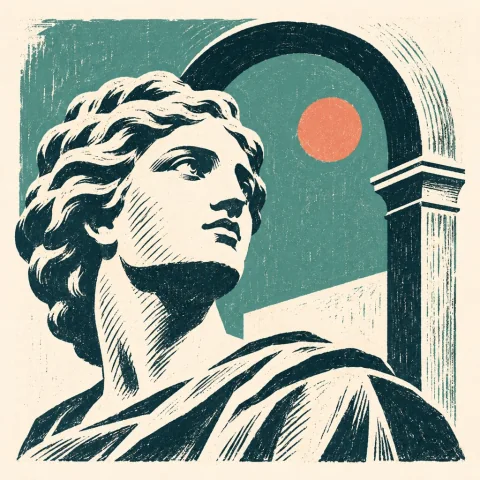

How does a picture tell your eyes where to go?
The idea
Composition is how an image arranges shapes, colors, and space. A small bright shape can attract attention if the rest of the picture is dark. A line or a person’s gaze can send the eye toward another part of the scene.
A closer look
Try looking at an image for ten seconds. Identify what you noticed first and what you noticed next. Check whether size, contrast, placement, or repetition helped lead you there.
Make the connection
Viewers can respond differently. Describe evidence in the picture before drawing a conclusion about its effect.
Separate description from inference. 'A red circle sits near the upper edge' reports a feature; 'it creates tension' interprets an effect. You can support the interpretation through imbalance, contrast, or the direction of nearby forms. Try covering the bright area and observing how the rest of the picture reads. This comparison tests its role without assuming every viewer will respond identically. Composition can guide attention while still leaving room for several paths through an image.
Put the idea to work
Read the answer and explanation
Place a bright shape in a large area of dark tones.
Strong local contrast can make a shape stand out. Repeating identical emphasis everywhere can instead distribute attention across the image.
Put the idea to work
Read the answer and explanation
Point to shapes, colors, and positions that guide attention.
Observable shapes, positions, and colors support an account of emphasis. A reaction or title alone does not explain how the composition produces it.
A little more understanding
You followed a good question.
Keep the curiosity going with another lesson.
Sources & further reading
Keep the connection going