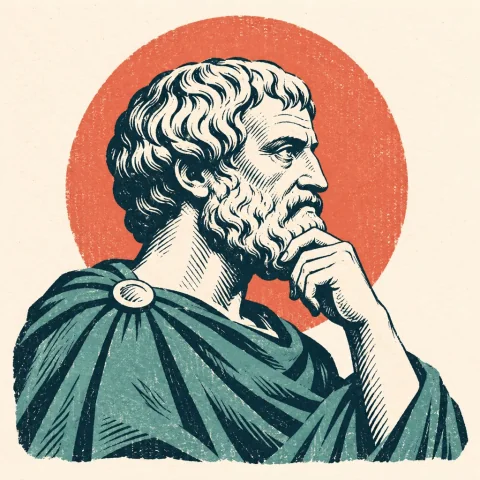

How do you become a good person?
The idea
For Aristotle, living well means exercising our abilities and virtues across a whole life. He calls this flourishing. A pleasant afternoon can be part of a good life, but flourishing is the larger pattern.
A closer look
We build character by repeatedly practicing the actions that make up a virtue. A person becomes more generous by actually giving wisely. Experience helps them see what is fitting in a particular situation.
Make the connection
Courage helps you judge when to face a real danger. Acting rashly and running from every risk can both miss what courage calls for. The right response depends on the circumstances.
The mean is relative to the person and situation, rather than an arithmetic midpoint. Giving half your savings is not automatically generous: it could neglect dependents or fail to meet an urgent need. Practical wisdom helps identify the relevant circumstances. Aristotle also recognizes that friendship, health, and external resources affect a flourishing life. His account therefore asks about the conditions of a whole life as well as the habits of an individual.
Put the idea to work
Read the answer and explanation
Living well by exercising virtues across a life.
Flourishing describes virtuous activity across a life, rather than one pleasant feeling or the possession of admired resources.
Put the idea to work
Read the answer and explanation
Jo practices generosity and learns to offer the help each situation calls for.
Virtue requires repeated action guided by practical judgment. Giving without considering the situation, or merely knowing a definition, does not establish that judgment.
A little more understanding
You followed a good question.
Keep the curiosity going with another lesson.
Sources & further reading
Keep the connection going