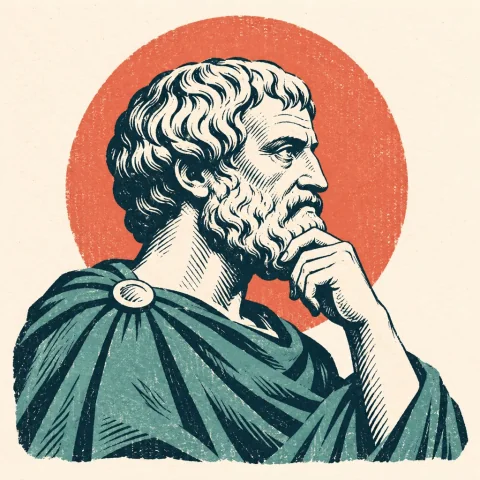

Why did Socrates ask so many questions?
The idea
In Plato’s dialogues, Socrates often begins by asking someone to explain an idea they already use, such as courage or justice. He then tests the answer against examples the person also accepts.
A closer look
Suppose a friend says courage means never retreating. Ask whether a firefighter who retreats to get help can still be courageous. If your friend says yes, the first definition needs work.
Make the connection
This is a way to examine a belief together. A conversation may end in puzzlement because spotting a contradiction can make room for a better answer.
The test has two stages: agree on a definition, then ask whether its consequences fit cases both speakers accept. If courage means never retreating, a careful rescue exposes a problem with the definition. It does not establish that retreating is always courageous. That would need another argument. Plato wrote literary dialogues, so their Socrates is also a character through whom philosophical problems are explored; they are not transcripts of every historical conversation.
Put the idea to work
Read the answer and explanation
A definition fails to cover a case it should explain.
A counterexample challenges whether a definition covers an accepted case. It exposes a problem without establishing a replacement definition by itself.
Put the idea to work
Read the answer and explanation
Does your rule also explain this difficult case?
The question tests a proposed rule against a difficult case. Agreement or confidence alone would not show that the rule explains courage.
A little more understanding
You followed a good question.
Keep the curiosity going with another lesson.
Sources & further reading
Keep the connection going